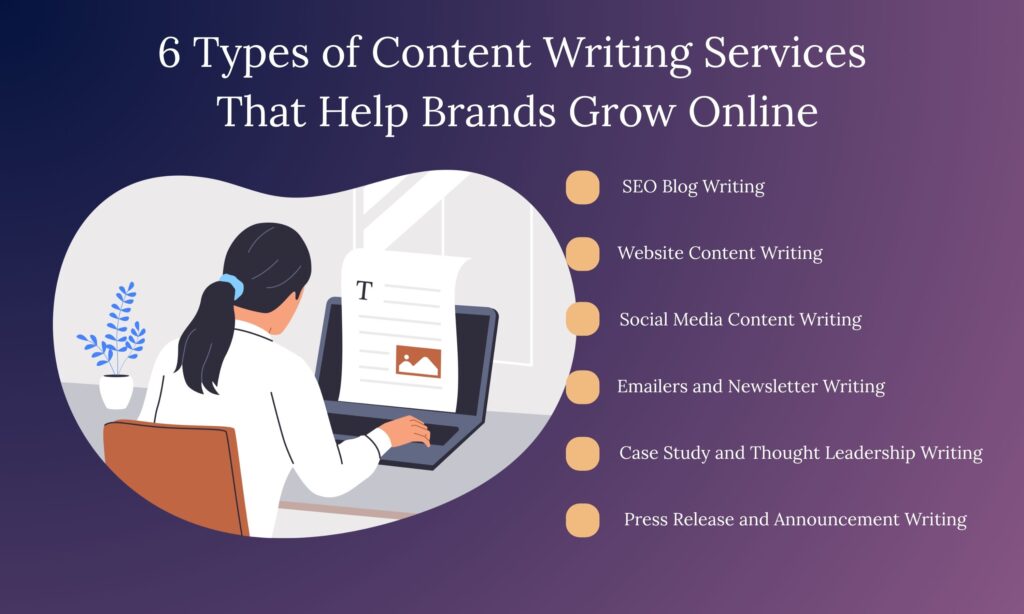
1. SEO Blog Writing
SEO blog writing is one of the most important content services for brands that want long-term organic visibility.
When users search for answers on Google, they are often looking for guidance before making a decision. A strong blog helps your brand appear during that research stage.
For example, a modular kitchen brand may want to rank for topics like “modular kitchen cost in Mumbai” or “best modular kitchen layouts for small homes.” A B2B manufacturing company may need blogs around product applications, industry standards, use cases, or buyer pain points.
Good SEO blog writing includes:
- Search intent understanding
- Keyword mapping
- Clear headings
- Helpful explanations
- Practical examples
- Internal links
- Strong meta title and description
- Natural keyword placement
The biggest mistake businesses make is writing blogs only for search engines. A good SEO blog should answer the user’s question clearly, completely, and practically.
The aim is not to repeat what every other website has already written. The aim is to give the reader something useful enough to help them make a better decision.
Best suited for:
Brands that want organic traffic, search visibility, topical authority, and long-term lead generation.
2. Website Content Writing
Your website is often the first serious interaction a potential customer has with your brand. If the content is unclear, generic, or too sales-heavy, users may leave without inquiring.
Website content writing includes homepage copy, about page copy, service pages, landing pages, product pages, FAQs, and contact page content.
The role of website content is to answer three questions quickly:
What do you offer?
Why should the customer trust you?
What should they do next?
Strong website content should be simple, structured, and conversion-focused. It should not overload users with jargon. It should guide them naturally from awareness to action.
For example, a service page should explain the problem, the solution, the process, the benefits, and the next step. It should also include proof points such as experience, industries served, case studies, testimonials, or process details.
Good website content does not just describe your services. It builds confidence in your ability to deliver.
Best suited for:
Businesses that are building a new website, revamping an old website, launching a new service, or improving lead conversion.
3. Social Media Content Writing
Social media content is not just caption writing. It is brand communication in a fast-moving environment.
For platforms like LinkedIn, Instagram, Facebook, and YouTube Shorts, content must capture attention quickly while staying aligned with the brand’s tone.
A strong social media content writer understands:
- Platform behaviour
- Hook writing
- Caption structure
- Campaign themes
- Brand voice
- Visual copy
- Call-to-action placement
- Hashtag relevance
- Content calendar planning
For B2B brands, social media content may focus on thought leadership, project updates, industry insights, employee stories, awards, and capability-led communication. For consumer brands, it may focus on awareness, engagement, offers, reels, lifestyle content, and community building.
The mistake many brands make is treating social media as daily posting. A better approach is to treat it as a brand-building channel where every post adds to recall, trust, or action.
Social media content should make the brand look active, relevant, and clear in what it stands for.
Best suited for:
Brands that want stronger online presence, regular engagement, better storytelling, and consistent brand visibility.
4. Emailers and Newsletter Writing
Email remains one of the most direct ways to communicate with customers, employees, partners, and prospects.
Unlike social media, where visibility depends on platform algorithms, email gives brands a more direct communication channel. But for email to work, the content must be sharp, relevant, and easy to act on.
Email writing can include:
- Promotional emailers
- Corporate announcements
- Internal communication
- Newsletters
- Product launch emails
- Event invitations
- Lead nurturing emails
- Follow-up emails
- Customer education emails
A good emailer should have a clear subject line, focused message, readable structure, and one strong call to action. It should not try to say everything at once.
For example, a B2B company launching a new service does not need a long email explaining every feature. It needs to explain the problem, the benefit, the proof, and the next step.
Email content works best when it respects the reader’s time.
Best suited for:
Brands that want to nurture leads, communicate with existing customers, promote services, or improve internal communication.
5. Case Study and Thought Leadership Writing
Case studies are among the most powerful content formats for building trust.
A case study shows how your brand solved a real problem. It gives potential customers a reason to believe your claims because it explains the challenge, approach, execution, and outcome.
A good case study usually includes:
- Client or industry context
- The business challenge
- The strategy or solution
- Execution details
- Results or impact
- Learnings
- Visual or data support
For B2B brands, case studies hold significant value because purchasing decisions aren’t made on a whim. Decision-makers are looking for proof. They want to know if the agency, vendor, or service provider has successfully navigated similar challenges in the past. Thought leadership content operates a bit differently.
It allows founders, CXOs, and senior executives to share their insights on industry trends, business challenges, and emerging opportunities. This type of content is ideal for LinkedIn articles, personal blogs, leadership posts, opinion pieces, and industry publications. Effective thought leadership isn’t about using complicated language; it’s about offering a clear and informed perspective that encourages the audience to think differently or make better choices.
Best suited for:
B2B companies, professional service firms, technology brands, infrastructure companies, consultants, agencies, and businesses with longer sales cycles.
6. Press Release and Announcement Writing
Press releases help brands communicate important updates in a formal and credible manner.
These updates may include:
- Product launches
- Business expansions
- Funding announcements
- Awards
- Partnerships
- Leadership appointments
- Events
- Milestones
- CSR initiatives
A press release should be factual, structured, and newsworthy. It should not read like an advertisement. Journalists, media platforms, and stakeholders need clarity, not exaggerated claims.
A strong press release includes a clear headline, opening summary, key announcement details, relevant quote, company boilerplate, and media contact information.
For growing businesses, press release writing can support brand credibility, online visibility, and reputation building.
Best suited for:
Brands with important announcements, corporate milestones, events, awards, launches, or partnerships.
How to Choose the Right Content Writing Service
Not every business needs every type of content at once.
Before hiring a content writing agency, ask these questions:
Do you need traffic?
Start with SEO blogs and website content.
Do you need stronger brand perception?
Focus on website copy, social media content, thought leadership, and case studies.
Do you need leads?
Use landing pages, emailers, SEO content, and performance campaign copy.
Do you need trust?
Build case studies, leadership content, press releases, and educational blogs.
Do you need consistency?
Create a monthly content calendar across blogs, social media, email, and campaigns.
Good content writing is not about producing more words. It is about creating the right content for the right audience at the right stage of the decision journey.
What Makes Content Truly Useful?
High-quality content should help the reader make a better decision.
That means it should be
- Clear
- Accurate
- Original
- Easy to read
- Specific to the audience
- Supported by real experience
- Structured for search and users
- Aligned with business goals
The most effective content doesn’t just aim to rank; it addresses the real problems customers face. Experience plays a crucial role here.
A skilled writing team knows how businesses communicate, how customers search for information, and how different digital platforms operate. Take blogs, for instance; they require a solid SEO framework. On LinkedIn, a compelling point of view is essential. For website service pages, clarity and a focus on conversions are key. Meanwhile, press releases should maintain credibility and restraint.
Each format has a different job. Good content writing understands that difference.
Why Work With a Content Writing Agency?
A content writing agency does more than just churn out random posts; it creates a cohesive content system. This approach ensures that your website, blog, social media, emails, and campaigns all communicate with a consistent brand voice. At Red Rock India, we align content writing with SEO, social media strategy, brand messaging, and overall business objectives.
It’s crucial to remember that content should never exist in a vacuum. Instead, it should enhance visibility, build trust, foster engagement, and drive conversions. No matter what you need—be it SEO blogs, website copy, social media captions, case studies, email newsletters, or press releases—the aim remains the same: to create meaningful connections that resonate with your audience.
Create content that helps your audience understand you better and trust you faster.
Conclusion
Choosing the right content writing service comes down to your business goals and how you want to engage with your audience. SEO blogs can help users discover your brand, while website content delivers a clear message about what you offer. Social media keeps your brand visible, and emails are key for staying connected with customers. Case studies build trust, and press releases enhance credibility. When these content types work in harmony, they become powerful tools for growth. If you’re looking for strategic, search-friendly content that prioritizes authentic communication, Red Rock India is ready to help you craft effective materials across various platforms. Speak to Red Rock India for content writing services that combine strategy, SEO, storytelling, and brand clarity.